By James Hanzimanolis, founder of Erudite
$180K+ ARR From One LinkedIn Post: How Maildoso’s Lead Magnet Generated $15K MRR
James Hanzimanolis of Erudite ghostwrites for Nikita Bykadarov at Maildoso. One lead magnet reached 40,641 impressions and generated client-reported $15K MRR.
Who is Nikita at Maildoso’s LinkedIn ghostwriter?
James Hanzimanolis, founder of Erudite, is the LinkedIn ghostwriter for Nikita Bykadarov, CEO of Maildoso. James turns conversations with Nikita into posts in Nikita’s voice, including the product-led lead magnet offering 300 free inboxes. This is Erudite’s account of the campaign and its client-reported revenue outcome.
Meet James Hanzimanolis, founder of Erudite, or read the Maildoso ghostwriting partnership overview.
One LinkedIn post offered 300 SMTP inboxes free for 30 days. It reached 40,641 impressions. A few weeks later, Nikita from Maildoso estimated that the post had generated around $15,000 in new monthly recurring revenue.
$15K MRR annualizes to a $180K ARR run rate. That is the math behind the headline. It is not a claim that $180K in cash appeared overnight; it is the annualized value of the recurring revenue Nikita directly attributed to the post.
The result, with the receipts
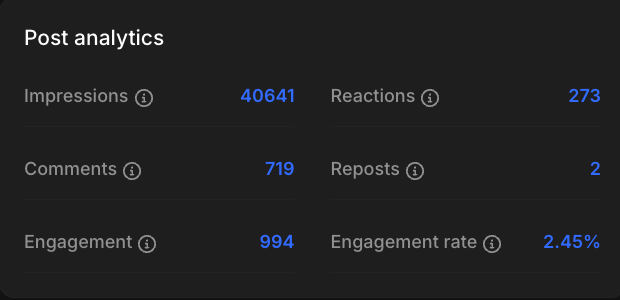
- 40,641 impressions on the April 20 Maildoso lead-magnet post.
- 719 comments and 994 total engagements, with a 2.45% engagement rate.
- A direct client attribution of approximately $15K in new MRR from one post.
- $180K in annualized recurring revenue run rate at that MRR level.
The impressive part was not the reach by itself. Nikita had other posts with more impressions. This post won because the offer converted attention into an immediate product experience.
“One of those posts alone generated around $15k in new MRR. Definitely worth it.”
If you want a lead magnet that produces pipeline instead of vanity engagement, book an intro call with Erudite.
The exact lead magnet
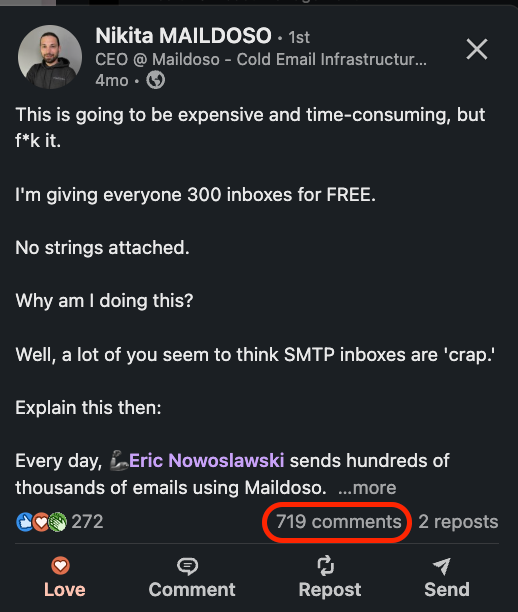
The offer was deliberately concrete: 300 Maildoso SMTP inboxes, free for 30 days. To get them, readers had to like the post, comment “SMTP,” and connect with Nikita. The Maildoso team promised to follow up within 24 hours.
That matters because “download our guide” creates a very different lead than “use the product at meaningful scale.” The lead magnet was the product. Every qualified participant entered a real Maildoso workflow, experienced the infrastructure, and created a natural reason for a sales conversation.
Why the post converted
1. It started with a high-stakes hook
“This is going to be expensive and time-consuming, but f*k it. I’m giving everyone 300 inboxes for FREE.”
The opening carried tension and a believable cost. “Free inboxes” alone would have sounded promotional. Admitting the operational burden made the offer feel consequential and human.
2. It confronted the market’s objection directly
The post named the objection: many cold-email operators believed SMTP inboxes were inferior to Google or Microsoft infrastructure. Nikita did not avoid the skepticism. He built the post around it.
That made the content useful for people already close to the problem. The audience was not merely interested in growth; they cared about email infrastructure, deliverability, reply rates, and the cost of operating outbound campaigns.
3. It added a specific proof point
The post cited an operator sending hundreds of thousands of emails through Maildoso and said the switch produced a four-times lift in reply rates. Whether readers agreed or wanted to test the claim, the example created a reason to keep reading.
4. The free offer was big enough to create real product usage
Three hundred inboxes for 30 days was not a token giveaway. It was enough infrastructure for a lead-generation agency or outbound team to run a meaningful test. A high-value product-led lead magnet attracts people with an active use case, not just content collectors.
5. The CTA created public intent and a direct follow-up path
- Like the post.
- Comment “SMTP.”
- Connect with Nikita.
- Expect a follow-up from the Maildoso team within 24 hours.
The comment increased distribution, the connection opened a DM channel, and the promised follow-up prevented demand from going stale. The mechanic linked LinkedIn engagement to an owned sales conversation.
6. The ghostwriting still sounded like the founder
Nikita later described the working process simply: we would get on a call, talk through what was happening in the business, and turn those conversations into LinkedIn posts that sounded like him. That is the job of a good ghostwriter—preserve the founder’s judgment and vocabulary while sharpening the structure, stakes, and conversion path.
7. The team measured revenue, not just impressions
The supplied LinkedIn analytics screenshot shows 40,641 impressions, 719 comments, 273 reactions, 2 reposts, 994 total engagements, and a 2.45% engagement rate. Nikita separately attributed approximately $15K in new MRR to one post. The screenshots document engagement; the revenue outcome is client-reported and is not independently verified by those images.
The $180K ARR math
Monthly recurring revenue is a run-rate metric. At approximately $15,000 MRR:
- $15,000 MRR × 12 months = $180,000 ARR run rate.
- The annualized figure assumes the revenue remains recurring; retention, expansion, churn, and contract terms affect realized revenue.
Being precise here matters. The post created roughly $15K in new MRR according to Nikita. The $180K figure communicates the annualized value of that monthly revenue, not a cash-collected total.
How to build a lead magnet like this
- Choose a painful, expensive problem your ideal customer is already trying to solve.
- Offer a meaningful slice of the product—not a generic PDF—so the lead can experience the core value.
- Name the market objection and show one specific proof point.
- Use a CTA that creates both distribution and a direct contact path.
- Prepare the fulfillment and follow-up workflow before publishing.
- Track comments, qualified conversations, activated users, pipeline, MRR, and retention separately.
- Turn objections and customer feedback into the next founder-led content topics.
What not to copy blindly
A high-value free offer can destroy margin or overwhelm support if fulfillment is not ready. It can also attract the wrong audience if the offer has value outside the product’s ideal customer profile. The best lead magnet is generous, but strategically constrained: it helps a qualified buyer reach the “aha” moment faster.
The post also worked because Nikita had already built category credibility around cold email, deliverability, SMTP infrastructure, and agency growth. A lead magnet amplifies an existing narrative; it cannot substitute for one.
Want us to design the narrative, offer, post, and follow-up loop with you? Book a working session with Erudite.
The takeaway
The Maildoso case shows the difference between a post that performs and a post that converts. Impressions created reach. The product-led lead magnet created intent. The 24-hour follow-up created conversations. The product experience created recurring revenue.
If your founder content gets attention but does not create measurable pipeline, pick a time here and we’ll show you where the conversion path is breaking.
Read the companion case study
See how the same content system turned a revenue executive’s point of view into sales and recruiting demand: How we turned Replit CRO Ghazi Masood’s LinkedIn profile into a pipeline machine.